
![Average Land Surface Temperature [Day]](/images/datasets/132x66/MOD_LSTD_CLIM_M.jpg)
![Average Land Surface Temperature [Night]](/images/datasets/132x66/MOD_LSTN_CLIM_M.jpg)

![Land Surface Temperature Anomaly [Day]](/images/datasets/132x66/MOD_LSTAD_M.jpg)
![Land Surface Temperature Anomaly [Night]](/images/datasets/132x66/MOD_LSTAN_M.jpg)
![Land Surface Temperature [Day]](/images/datasets/132x66/MOD_LSTD_M.jpg)
![Land Surface Temperature [Night]](/images/datasets/132x66/MOD_LSTN_M.jpg)






NEO News
Goodbye, NEO
June 1st, 2026 by Kevin Ward
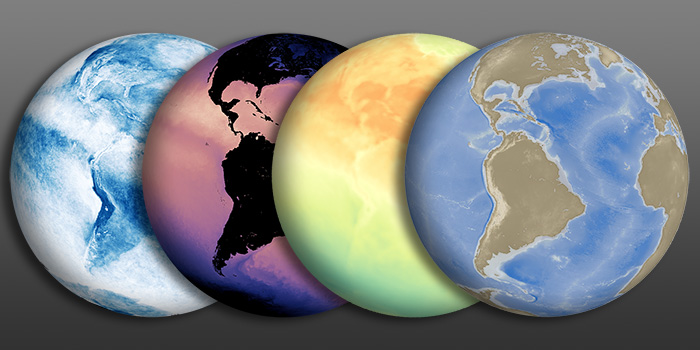
After over 20 years of continuous delivery of global NASA data imagery, NASA Earth Observations (NEO) is going to say goodbye. The Web Mapping Service (WMS) will shut down on August 3July 30, 2026, and the website will be turned off on September 1, 2026.
It has been a pleasure and a career achievement to have developed this site and the underlying services. There are many colleagues and team members who assisted in the big lift over the years; I could not have accomplished so much with NEO without their support and expertise.
NEO imagery is derived from NASA data, meaning it can be reproduced. I am hoping to provide the source code for data processing (mostly Python) in the event anyone would find that useful. There are a couple online sources that I routinely use that you might explore as NEO-alternatives; they might even be an improvement depending on your particular use case. (There are many more tools you might peruse; please visit the Earthdata data tool matrix).
- NASA Worldview – Thousands of global data layers in an easy-to-use interface, plus it includes the ability to adjust color palettes, generate animations and comparisons, and so much more.
- NASA Giovanni and NASA AppEEARS – Browse, visualize, composite, and analyze NASA science data including the ability to geospatially subset datasets. Particularly useful for users who want to analyze data.
For WMS users, I recommend investigating NASA’s Global Imagery Browse Services (GIBS) for various OGC service APIs.
For example, the snippet below uses gdal_translate to query GIBS for a 3600×1800 global image of MODIS/Terra Corrected Reflectance on NEO’s birthday (November 23, 2005):
gdal_translate -q -of JPEG -outsize 3600 1800 -projwin -180 90 180 -90 "<GDAL_WMS><Service name='TMS'><ServerUrl> https://gibs.earthdata.nasa.gov/wmts/epsg4326/best/MODIS_Terra_CorrectedReflectance_TrueColor/default/2005-11-23/250m/\${z}/\${y}/\${x}.jpg</ServerUrl></Service><DataWindow><UpperLeftX>-180.0</UpperLeftX><UpperLeftY>90</UpperLeftY><LowerRightX>396.0</LowerRightX><LowerRightY>-198</LowerRightY><TileLevel>8</TileLevel><TileCountX>2</TileCountX><TileCountY>1</TileCountY><YOrigin>top</YOrigin></DataWindow><Projection>EPSG:4326</Projection><BlockSizeX>512</BlockSizeX><BlockSizeY>512</BlockSizeY><BandsCount>3</BandsCount></GDAL_WMS>" gibs_example_image.jpgThank you to all of you who found NEO useful and provided feedback over the years.
- Browse by Topic
- Analysis
- NEO in the Media
- New Datasets
- Services
- Uncategorized
- Browse by Date
- June 2026
- July 2025
- August 2024
- May 2023
- April 2021
- February 2021
- December 2020
- November 2020
- October 2020
- September 2020
- June 2019
- March 2019
- April 2015
- April 2014
- December 2013
- November 2013
- August 2013
- March 2013
- June 2012
- June 2011
- April 2011
- November 2010
- August 2010
- February 2009
- May 2008
- April 2007


